China has become a major source of permanent magnet motor technology, serving automation, electric vehicles, pumps, compressors, and precision equipment. Yet choosing a supplier involves more than comparing catalog prices. A polished brochure cannot tell you how a motor behaves after months of heat, vibration, and frequent starts.
This guide to the Best Permanent Magnet Motor Manufacturers in China introduces manufacturers through practical criteria: product range, engineering support, customization, quality systems, and evidence of application experience. R. Krishnan, a recognized motor-drive researcher and author, has explored how motor design and drive requirements work together. A useful paraphrase of his engineering perspective is: “Evaluate a motor in its real operating conditions, not by specifications alone.” That distinction matters. A compact motor may suit a conveyor but struggle with a demanding duty cycle.
Look closely at operating speed, torque, cooling, insulation, control compatibility, and service access. Ask for test reports and clarify what they cover. Where possible, compare performance data under similar conditions; figures from different test setups can mislead. The strongest manufacturers explain trade-offs clearly and support their claims with verifiable documentation. Small details count. Connector placement can complicate installation. A slow technical reply can also reveal a gap in support.
No shortlist is perfect. Supplier capabilities change, and a good fit depends on your application, budget, and service expectations. The following overview offers a starting point—not a substitute for checking current specifications, factory capabilities, and customer references.
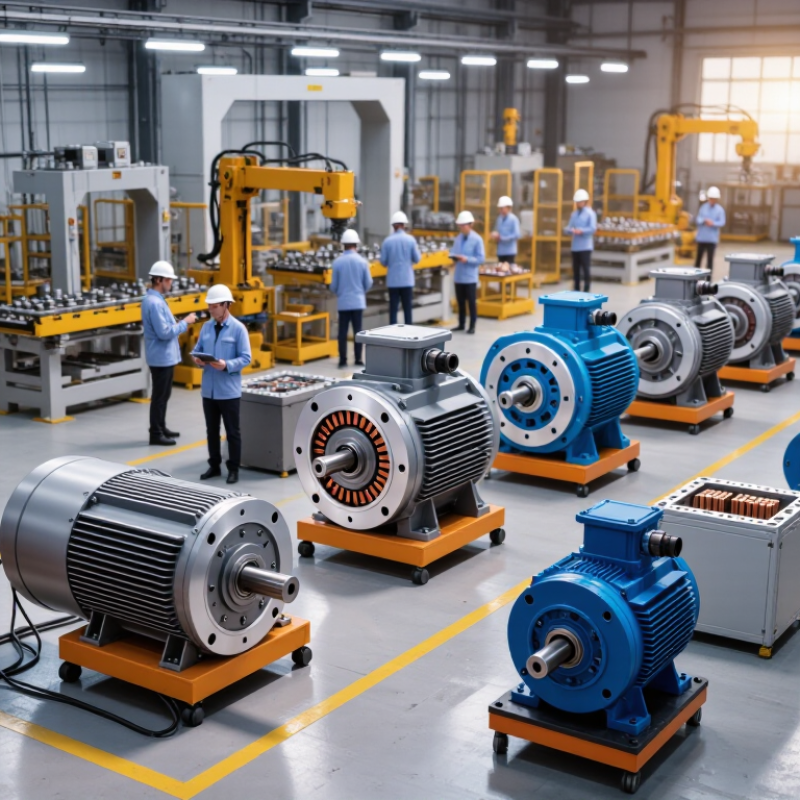
China’s permanent magnet motor industry combines magnet production, electrical-steel processing, precision machining, winding, and final assembly. Many manufacturers work with local suppliers for rotor shafts, stamped laminations, insulation, and control components. This can shorten procurement times, though supplier quality varies. Small gaps matter.
Designs may use different magnet grades and rotor layouts to balance torque, speed, heat resistance, and cost. Engineers also consider the motor’s actual duty cycle. A pump running steadily has different needs from a conveyor that starts and stops often. The best specification is not always the one with the highest rated efficiency.
Production checks can include rotor balancing, winding insulation tests, air-gap measurement, and vibration testing. Finished motors may be tested for temperature rise, torque, and operating noise under defined loads. Testing reveals flaws. Still, a clean test report cannot replace clear records of materials and process changes. Buyers should ask how magnet fixation, corrosion protection, and traceability are managed. These details can be easy to overlook.
Manufacturers are also adapting designs for compact equipment, variable-speed drives, and demanding thermal conditions. Some factories offer custom shafts or mounting dimensions, but customization can complicate replacement parts later. That trade-off deserves attention. The sector has strong manufacturing depth, yet consistency depends on process control, not production scale alone. A factory visit can show the real workflow, though one visit may not reveal every shift’s practices.
Chinese permanent magnet motor manufacturers rely on careful magnetic design, precise production, and testing under realistic loads. Engineers use finite-element analysis to model flux paths and reduce leakage before cutting steel. The model is useful, but it cannot replace a physical prototype. Small gaps matter.
Rotor design is a key challenge. Magnets may be mounted on the surface or embedded inside the rotor, depending on speed, torque, and operating conditions. High-strength retaining sleeves, accurate magnet placement, and balanced rotors help limit vibration at high speed. Thin electrical steel laminations reduce eddy-current losses, while winding choices affect torque smoothness and heat generation. Heat is unforgiving.
Manufacturers also pair motors with vector-control inverters, which adjust current to deliver torque efficiently across changing speeds. Cooling may use a finned housing, forced air, or liquid channels; the right choice depends on duty cycle and available space. During production, teams can check winding resistance, insulation, rotor balance, and temperature rise. These checks reveal issues that a catalog specification may miss. Still, simulations do not catch every assembly variation, and that gap deserves more attention than many product descriptions suggest. A motor tested only at room temperature may behave differently after hours of heavy load.
NdFeB magnet grade selection is a key design consideration in permanent magnet motors. Higher-temperature grades typically use formulations designed to improve resistance to demagnetization. Values shown are common nominal maximum operating temperatures; actual limits depend on the specific magnet, motor design, and operating conditions.
China’s leading permanent magnet motor manufacturers compete on more than compact designs. Their strengths often include integrated magnet sourcing, precision machining, automated winding, and broad production capacity. That matters because motor systems consume an estimated 43–46% of global electricity, according to the International Energy Agency’s 2011 report, Energy-Efficiency Policy Opportunities for Electric Motor-Driven Systems. Even small efficiency gains can matter at fleet scale. In a factory, practical differences show up in winding consistency, rotor balance, temperature rise, and vibration under prolonged load—not just rated efficiency on a datasheet. Details matter.
Supply-chain depth is another advantage, but it does not guarantee performance. The IEA’s Global Critical Minerals Outlook 2024 reports that China accounts for about 90% of global rare-earth separation and refining capacity. This supports magnet availability, while making material traceability and planning important questions for buyers. When assessing manufacturers, request test conditions, torque-speed curves, insulation class, demagnetization limits, and efficiency maps across operating points. Ask for production-batch repeatability data, too. A sample unit may perform well; the ten-thousandth can tell a different story. Service response and spare-part lead times deserve attention. Comparisons remain imperfect because duty cycles and measurement methods vary between suppliers.
Chinese permanent-magnet motor manufacturers vary by product range and engineering depth. Some specialize in compact servo motors; others build traction, industrial, or direct-drive units. A broad catalogue does not prove strong customization. Different jobs need different evidence.
The US Department of Energy’s 2014 motor-system sourcebook estimates that motor-driven systems account for about 68% of electricity use in US manufacturing. That makes efficiency data more useful than a power rating alone. Ask for test results at the intended load and speed, not just peak efficiency. The IEA’s Global Critical Minerals Outlook 2024 reports that China accounts for roughly 90% of rare-earth refining. This supports strong material access, but it does not guarantee consistent magnets or finished-motor quality. Details matter.
Compare suppliers on cooling design, rotor balance, insulation, control compatibility, and documented quality checks. Request performance curves, temperature-rise results, and sample test records. For a 3,000-rpm machine, ask how vibration and heat change under continuous load. Check whether the manufacturer can adjust shaft dimensions or mounting points without disrupting production schedules. Not always. Even capable suppliers may provide uneven documentation, so clarify test methods and acceptance limits before evaluating quotations.
This category-based comparison outlines common product and engineering capabilities available from Chinese permanent magnet motor manufacturers. It is not a ranking of individual suppliers; specifications depend on the motor design, operating conditions, and project requirements.
| Manufacturer Category | Typical Product Focus | Common Applications | Capability Strengths | Key Evaluation Points |
|---|---|---|---|---|
| Low-Voltage Industrial Motor Specialists | Permanent magnet synchronous motors for low-voltage operation, including customized frame sizes and mounting arrangements. | Pumps, fans, compressors, conveyors, and other industrial equipment. | Often support motor-and-drive matching, application-specific winding designs, and adaptations for existing equipment. | Check the rated duty, speed range, cooling method, enclosure protection, insulation system, and test documentation for the exact model. |
| High-Voltage Motor Specialists | Medium- and high-voltage permanent magnet synchronous motors designed for larger industrial loads. | Large pumps, fans, compressors, and process-industry machinery. | Can provide project-specific electrical and mechanical designs, with integration planning for the plant power system and drive. | Review voltage and frequency requirements, starting method, protection, cooling, bearing arrangement, installation conditions, and applicable test standards. |
| Servo and Motion-Control Motor Suppliers | Permanent magnet servo motors, commonly supplied with compatible feedback devices and drive options. | Machine tools, packaging equipment, robotics, and automated production lines. | Focus on dynamic response, speed and torque control, feedback integration, and coordination with motion-control systems. | Compare continuous and peak torque ratings, inertia, encoder interface, overload duty, drive compatibility, and commissioning support. |
| Direct-Drive Motor Specialists | Low-speed, high-torque permanent magnet motors that can be coupled directly to a load in suitable applications. | Rotary tables, industrial drives, mixers, and selected applications traditionally using a gearbox. | May simplify a drive train by reducing or removing the need for mechanical speed reduction, depending on the load and operating point. | Confirm required torque across the full speed range, thermal limits, rotor inertia, mounting constraints, and whether a gearbox is actually unnecessary. |
| Traction and Vehicle-Motor Suppliers | Permanent magnet traction motors and related motor-drive systems for vehicle platforms. | Electric vehicles, electric buses, and selected off-highway or special-purpose vehicles. | Experience may include compact packaging, high-speed operation, liquid cooling, and integration with vehicle power electronics. | Assess duty-cycle data, peak and continuous output, cooling interfaces, environmental requirements, safety validation, and vehicle-level test evidence. |
| Custom OEM and Application-Engineering Manufacturers | Motors developed or adapted to customer-specific dimensions, electrical parameters, interfaces, and operating environments. | Special machinery, replacement projects, and equipment with non-standard operating requirements. | Can support prototype development, design-for-manufacturing changes, sample testing, and production planning for an agreed specification. | Ask for a written specification, prototype acceptance criteria, change-control process, production traceability, and a clear division of design responsibility. |
Comparison note: Product availability and performance vary by supplier and model. Confirm efficiency, output, operating range, certification, and delivery capability against the specific datasheet and test reports. Certifications and approvals are model- and market-specific and should not be assumed for an entire product category.
Choosing a Chinese permanent magnet motor manufacturer starts with matching its capabilities to your actual operating conditions. Define the required speed, torque, duty cycle, and available installation space. A motor running continuously near a hot pump needs different thermal margins from one used intermittently in a small conveyor. Ask how the manufacturer selects magnet grades and protects against demagnetization. Request efficiency figures with the test conditions, not just a headline percentage. Details matter. Compare sample measurements with the drawing, including shaft dimensions, mounting holes, and winding data. A small mismatch can create expensive assembly delays.
Review production controls as carefully as the motor design. Ask how rotor balance, winding resistance, and insulation are checked, and whether results are recorded by batch. Clear traceability helps when performance varies between deliveries. Check whether engineers can explain design trade-offs in plain language and respond with specific test evidence. A polished catalog is reassuring, but it can hide gaps in process control. I would not treat one successful prototype as proof of stable mass production; that assumption deserves a second look. If possible, inspect a production line or request a pilot batch, then test it under a realistic load and temperature cycle. Also discuss lead times, spare parts, and communication during design changes before placing a large order.
It combines magnet production, steel processing, precision machining, winding, and final assembly. Small gaps matter.
They consider torque, speed, heat, cost, and the machine’s duty cycle. A steady pump differs from a conveyor that starts and stops often. Highest rated efficiency is not always the best fit.
Ask about rotor balancing, insulation tests, air-gap measurement, vibration, and temperature-rise testing. Records matter too.
A motor may behave differently after hours of heavy load than during a room-temperature test. Ask for results at your intended speed and load. Catalog figures can miss details.
Surface-mounted or embedded magnets suit different operating conditions. Finned housings, forced air, and liquid channels also vary in their space and cooling needs. Heat is unforgiving.
Review performance curves, temperature-rise results, sample test records, insulation, rotor balance, and control compatibility. A broad catalogue proves little by itself.
Custom dimensions can suit a machine, but may make replacement parts harder to source. Check how changes affect production schedules. I would not assume customization is effortless.
No. Material access does not ensure consistent magnets or finished motors. Ask how materials, process changes, and acceptance limits are documented. One factory visit may not show every shift’s practices.
China has become an important center for Permanent Magnet Motor manufacturing, supported by a broad industrial supply chain and growing expertise in motor design and production. Manufacturers apply technologies such as high-performance magnetic materials, precision engineering, efficient cooling, and integrated control systems to improve performance, reliability, and energy use. Their products serve a range of applications, with capabilities varying in areas such as motor types, customization, production scale, and technical support.
When comparing Chinese manufacturers, buyers should consider more than product specifications. Factors such as engineering experience, quality-control processes, testing capability, production capacity, communication, and after-sales service can all affect a project’s outcome. A careful assessment of these strengths, alongside the motor’s intended operating conditions and required performance, can help identify a suitable manufacturing partner.

Micprec Motor