What Is a Coreless Motor and How Does It Work?

Time:2026-10-03 Author:Aria
0%

A Coreless Motor is a compact DC motor designed without the traditional iron core inside its rotor. Instead, its winding forms a lightweight, self-supporting cylinder that rotates around permanent magnets. This structure reduces rotor inertia, allowing rapid starts, stops, and direction changes. It also limits magnetic saturation and improves responsiveness in precision equipment. Think of a camera lens adjusting smoothly, a surgical instrument making tiny corrections, or a robotic gripper reacting within milliseconds.

The demand for compact motion systems is expanding. The International Federation of Robotics reported 4.664 million industrial robots operating worldwide in 2023, showing the growing need for precise and responsive actuators. The International Energy Agency also recorded more than 17 million electric car sales in 2024, reinforcing broader investment in efficient motor technologies. These reports do not measure coreless motors directly. That distinction matters. However, they reveal the automation and electrification trends supporting their use.

A coreless design typically combines a cylindrical winding, permanent magnets, a commutator, brushes, and a precision bearing system. When current enters the winding, electromagnetic force interacts with the magnetic field. The rotor turns, producing mechanical output. Its low moving mass creates excellent acceleration, but performance is not flawless. Brush wear, heat buildup, and limited overload tolerance can affect service life. Engineers must balance speed, torque, noise, efficiency, and cost for each application. A smaller motor is not automatically a better motor. Understanding that compromise is essential when evaluating how a Coreless Motor works.
What Is a Coreless Motor and How Does It Work?

Coreless Motor: Definition and Basic Structure

What Is a Coreless Motor and How Does It Work?

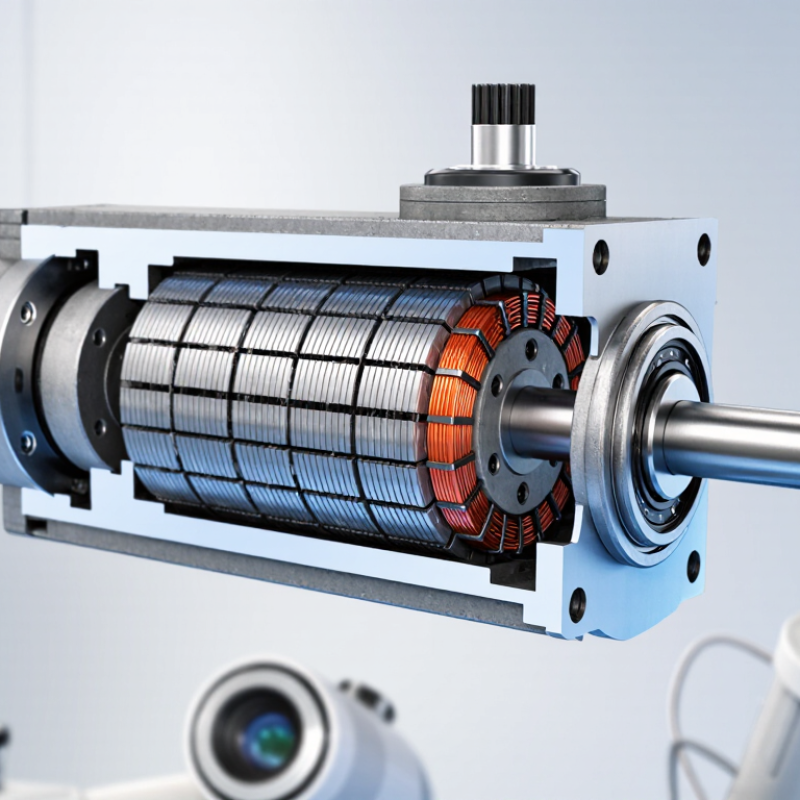
A coreless motor is a compact electric motor whose rotor has no traditional iron core. Instead, copper windings form a lightweight cylindrical basket. This basket rotates around permanent magnets, while a shaft and bearings support smooth movement. The stationary parts usually include the magnets, housing, brush assembly, and electrical connections. The design is simple in appearance, but its operation depends on careful magnetic alignment.

When current enters the copper windings, it creates a magnetic field. This field interacts with the permanent magnets and produces rotational force. A commutator and brushes switch the current direction as the rotor turns. This keeps the torque moving in one direction. Without an iron core, the rotor has lower inertia and less magnetic loss. It can accelerate quickly and respond to small control changes. However, the open winding structure may remove heat less effectively. That detail is sometimes underestimated. Continuous heavy loading can still damage the motor.

Tips: Check the motor’s rated voltage and current before testing. Use a stable power supply. Short bursts are safer during early trials. Listen for uneven noise, and feel for unusual heat. A coreless motor may look cool while operating beyond its limits. Its small size is not proof of unlimited durability. For precise applications, measure speed under load rather than relying on no-load performance.

What Is a Coreless Motor and How Does It Work?

A coreless motor uses a lightweight air-core winding instead of a conventional slotted iron armature. The coil is positioned in the magnetic field of permanent magnets, and current flowing through the winding produces torque. Removing the iron core reduces rotor inertia, which supports fast acceleration, braking, and direction changes.

Coreless Rotor

The copper winding forms a self-supporting cylindrical rotor with no laminated iron core inside it.

Magnetic Field

Permanent magnets create the stationary magnetic field. The interaction between this field and coil current generates rotational force.

Why It Responds Quickly

Without an iron armature, the rotor has lower inertia and avoids iron-core losses such as hysteresis and eddy-current losses.

The chart shows representative relative magnetic permeability values. Electrical steel varies widely by grade and operating condition; the values are intended for structural comparison rather than a specific motor rating.

How a Coreless Motor Converts Electricity into Motion

A coreless motor converts electricity into motion without using an iron core inside its rotor. Instead, copper windings form a lightweight cylindrical coil. Permanent magnets surround this coil and create a stable magnetic field. When direct current enters the windings, it produces another magnetic field. The interaction creates Lorentz force, pushing the coil around the shaft. Mechanical motion begins almost instantly.

The process depends on controlled current switching. A commutator or electronic controller changes the current direction as the rotor turns. This keeps the magnetic force moving in the correct direction. Because the rotor has little iron, it has low inertia and responds quickly to voltage changes. The U.S. Department of Energy’s Motor Systems Market Assessment estimates that motor-driven systems consume about 46% of global electricity. Even small efficiency gains therefore matter across many machines. The International Energy Agency also identifies electric motor systems as major global electricity users.

Removing the iron core reduces cogging and improves smoothness, especially at low speed. It also reduces rotor weight. However, the design has a weakness. Copper windings must release heat through limited surface area. Excessive current can raise temperature quickly and damage insulation. Efficiency is not automatic. Engineers must balance winding resistance, magnetic strength, load, and cooling. Tests should follow IEC 60034-2-1 measurement principles, yet real operating conditions remain messier than laboratory figures. That trade-off is easy to underestimate.

Key Operating Steps Inside a Coreless Motor

What Is a Coreless Motor and How Does It Work?

A coreless motor replaces the traditional iron armature with a lightweight coil structure. The coil is wound around a hollow support, leaving the rotor without an iron core. This small change reduces rotor mass and magnetic drag. In practice, the rotor can accelerate quickly, even from a standstill. That response is useful in precision equipment, small pumps, and compact motion systems.

Key Operating Steps Inside a Coreless Motor

Electrical current enters through the brushes and commutator. The commutator switches current between coil sections as the rotor turns. Each energized coil creates a magnetic field around the hollow rotor. This field interacts with the permanent magnet’s field inside the motor. The resulting attraction and repulsion produce torque. The rotor then spins, and the switching cycle continues.

No iron core is present.

Because the rotor has low inertia, speed changes feel almost immediate. There is also less cogging, so rotation can be smoother at low speed. However, the design is not flawless. The coil has limited space for heat to escape, especially during long operation. Excessive current may raise winding temperature and shorten service life. Engineers therefore check current, duty cycle, ventilation, and brush wear during testing. A coreless motor may seem simple, but stable performance depends on careful electrical and thermal control.

Advantages and Limitations of Coreless Motor Design

A coreless motor replaces the traditional iron armature with a lightweight coil, often shaped like a cup. The coil rotates inside permanent magnets. With less rotating mass, acceleration becomes extremely quick. Response feels almost immediate. There is also little magnetic cogging, so motion can remain smooth at low speed. This suits surgical tools, camera mechanisms, laboratory instruments, and compact robotics.

The International Energy Agency reports that electric motors consume roughly half of global electricity. That figure makes efficiency important, even in small actuators. However, a coreless design is not automatically more efficient in every operating condition.

Its main advantage is dynamic performance. Low inertia reduces startup energy and improves positional control. It can also reduce vibration and acoustic noise. The limitation appears during sustained load. Without an iron core, the winding has less thermal mass and may overheat sooner. Continuous torque can be lower than expected, especially in a narrow housing.

Engineers must examine winding resistance, duty cycle, heat paths, and peak current together. The U.S. Department of Energy has reported that motor-driven systems use about 70 percent of industrial electricity in the United States. Small efficiency losses can therefore accumulate across large equipment fleets. Still, laboratory figures can mislead. Real assemblies include bearings, controllers, friction, and imperfect cooling. A coreless motor may deliver beautiful acceleration, then disappoint under constant torque. Careful thermal testing remains necessary.

Common Applications of Coreless Motors

A coreless motor replaces the traditional iron core with a lightweight, wound rotor. This design reduces inertia and removes magnetic cogging. The result is quick, quiet, and precise motion. These qualities suit applications requiring frequent starts, stops, and position changes. Small medical pumps use coreless motors to deliver controlled fluid volumes. Robotic grippers also depend on their fast response. A slight delay can damage a delicate object.

Coreless motors appear in camera focusing systems, compact surgical instruments, powered prosthetics, and laboratory automation. Their low vibration helps optical systems adjust smoothly. Their small size also fits inside wearable devices and miniature joints. The World Health Organization estimates that 2.5 billion people need assistive products today. That figure may reach 3.5 billion by 2050. This creates practical demand for compact actuation in prosthetic hands and mobility devices. In industrial robotics, the International Federation of Robotics recorded 541,302 new robot installations in 2023. Not every robot uses a coreless motor. However, small end effectors and feedback mechanisms often benefit from one.

There is a trade-off. The rotor can heat quickly under heavy loads because it lacks an iron path for heat transfer. Engineers must check duty cycles, winding temperature, and stall conditions. Some application reports appear too optimistic about efficiency. Real performance depends on gear friction, controller quality, and cooling. A coreless motor is not automatically the best choice. It is best where speed, precision, and low inertia matter more than continuous high torque.

What Is a Coreless Motor and How Does It Work? – Common Applications of Coreless Motors

Technical overview, operating characteristics, representative performance ranges, and typical application areas

Data Dimension Coreless Motor Characteristic How It Works or Why It Matters Typical Practical Range or Example Common Applications
Basic Definition A permanent-magnet DC motor with a hollow, self-supporting winding rather than a conventional iron armature core. The winding rotates in the magnetic field while the absence of an iron core reduces magnetic mass, cogging, and eddy-current losses. Usually used where low inertia, compact size, and precise motion are more important than maximum continuous power. Precision actuators, miniature pumps, optical systems, medical instruments, and portable equipment.
Main Construction Permanent magnets, a cylindrical coreless winding, commutator and brushes or an electronic commutation system, bearings, shaft, and housing. The winding is commonly formed as a cup or bell-shaped structure that rotates around or outside the permanent-magnet assembly. Brushed and brushless versions are available; the selected design depends on service life, control requirements, and operating environment. Brushed designs for simple compact drives; brushless designs for longer operating life and reduced maintenance.
Operating Principle Electrical current in the winding produces electromagnetic torque through interaction with the permanent-magnet field. In a brushed design, the commutator mechanically switches current. In a brushless design, an electronic controller switches the phases. Torque is approximately proportional to current, while generated back electromotive force is approximately proportional to rotational speed. Closed-loop servo systems, proportional valves, camera mechanisms, and automated positioning systems.
Rotor Inertia Very low compared with many conventional iron-core armatures of similar size. Less rotating mass allows faster acceleration, deceleration, and reversal, improving dynamic response. Acceleration response can be in the millisecond range in small, properly controlled systems; the exact value depends on load and drive electronics. Fast autofocus mechanisms, miniature robotics, pick-and-place devices, and high-response servo actuators.
Cogging Torque Very low or nearly absent because the rotor does not contain conventional toothed iron laminations. Reduced magnetic detent torque helps the motor start smoothly and move with less speed ripple at low speed. Suitable for applications requiring smooth low-speed operation and fine incremental movement. Optical scanners, laboratory instruments, precision valves, and small positioning mechanisms.
Speed Capability High speed is possible because the rotor has low inertia and no iron core subject to substantial core losses. Speed is limited by winding strength, commutation, bearing capability, voltage, thermal conditions, and mechanical balance. Small coreless motors commonly operate from several thousand to tens of thousands of revolutions per minute; some specialized designs operate above 50,000 rpm. Miniature fans, dental or surgical handpieces, pumps, blowers, and high-speed positioning systems.
Torque Behavior High torque-to-weight ratio for its size, but continuous torque is constrained by winding temperature and heat dissipation. Because the winding has no iron heat sink, copper losses can raise the temperature quickly during overload or stall conditions. Peak torque is often substantially higher than continuous torque for short periods; actual values range from millinewton-metres in miniature units to higher values in larger designs. Short-stroke actuators, robotic grippers, dosing systems, and intermittent motion mechanisms.
Electrical Efficiency Can provide high efficiency at its intended operating point, particularly where low rotor losses and rapid transient response are valuable. Efficiency depends on winding resistance, operating speed, magnetic circuit, controller losses, and load profile. Well-designed small systems may achieve approximately 70%–90% peak motor efficiency, while the system-level value can be lower. Battery-powered tools, portable medical equipment, mobile devices, and energy-sensitive automation.
Thermal Management More thermally sensitive than many iron-core motors because the rotating winding has limited direct access to the housing. Heat is transferred through the winding support, air movement, shaft, bearings, and surrounding structure; continuous overload can damage insulation. Continuous operation should be evaluated using winding temperature, duty cycle, ambient temperature, and allowable insulation temperature. Applications with controlled duty cycles, forced airflow, heat-conductive housings, or strict current limiting.
Control Requirements Can be operated with a basic DC supply and mechanical commutation, or with a dedicated electronic controller for brushless operation. Speed and position control are improved by pulse-width modulation, current regulation, Hall sensors, encoders, or sensorless control. Closed-loop control is preferred when accurate speed, position, torque, or repeatability is required. Servo drives, medical pumps, precision instruments, camera modules, and automated inspection equipment.
Service Life Brushless coreless motors generally offer longer service life than brushed versions under comparable conditions. Brushed designs experience brush and commutator wear, while brushless designs eliminate these primary wear components but still depend on bearing life and insulation reliability. Service life varies from hundreds or thousands of hours for heavily loaded brushed operation to many thousands of hours for suitable brushless applications. Brushless: medical, aerospace, laboratory, and continuous-duty equipment. Brushed: intermittent consumer and low-cost mechanisms.
Noise and Vibration Low cogging and low rotor inertia can reduce mechanical vibration, although brush noise, bearing noise, PWM noise, and imbalance may remain. Mechanical and electrical noise depend on commutation method, switching frequency, mounting, balance, and load. Brushless control and balanced rotor construction are generally preferred for acoustically sensitive products. Audio equipment, optical devices, medical instruments, miniature fans, and laboratory systems.
Size and Weight High power density and compact dimensions are possible because the motor avoids a heavy iron armature. The compact rotating assembly can reduce actuator mass, which is valuable in moving mechanisms and handheld products. Often selected for miniature drives from a few millimetres to several centimetres in diameter, depending on the required output. Wearable devices, small robotics, compact pumps, camera modules, and portable instruments.
Key Advantages Low inertia, low cogging, quick acceleration, smooth operation, compact construction, and strong dynamic response. These characteristics make the motor effective when rapid, precise, and reversible motion is required. Best suited to low-to-moderate power systems with demanding response or space constraints. Precision motion control, miniature automation, medical devices, and portable electronics.
Main Limitations Limited heat dissipation, possible winding deformation, lower overload tolerance, and higher control or manufacturing complexity. The lack of an iron core improves dynamics but removes a convenient thermal path and mechanical support structure. Motor selection must consider stall current, duty cycle, winding temperature, bearing load, commutation, and mounting conditions. Less suitable for prolonged stall, severe shock, very high continuous torque, or applications requiring a low-cost high-power drive.
Selection Criteria Voltage, continuous and peak torque, speed, acceleration, duty cycle, allowable temperature, control method, shaft load, and service life. A motor should be selected from its complete operating curve rather than from speed or torque alone. Check the torque-speed curve, winding resistance, thermal limits, rotor inertia, encoder compatibility, and controller requirements. Any application requiring a compact, responsive, and precisely controllable rotary actuator.

Note: The numerical ranges shown are representative engineering ranges rather than universal specifications. Actual performance depends on motor diameter, winding design, magnet strength, controller settings, cooling, load, duty cycle, and operating temperature.

FAQS

What is a coreless motor?

It uses a lightweight coil instead of a traditional iron armature. The coil rotates around a hollow support. No iron core.

How does a coreless motor create motion?

Current enters through brushes and a commutator. The commutator switches current between coil sections as the rotor turns. Magnetic attraction and repulsion create torque.

Why can a coreless motor accelerate so quickly?

Its rotor has very low mass and inertia. Less rotating mass allows rapid starts, stops, and speed changes. Response feels almost immediate.

Does a coreless motor run smoothly at low speed?

Usually, yes. Removing the iron core reduces magnetic cogging. This can create smoother movement, less vibration, and quieter operation.

Where are coreless motors commonly used?

They suit camera focusing systems, medical pumps, robotic grippers, and laboratory instruments. They also fit compact prosthetic joints and wearable devices.

What is the main limitation of a coreless motor?

Heat can build quickly inside the winding. The coil has limited space for cooling, especially inside a narrow housing. Heat remains the catch.

Can a coreless motor provide continuous high torque?

Not always. Sustained heavy loads may raise winding temperature and shorten service life. A motor can accelerate beautifully, then struggle under constant torque.

What should engineers check before choosing this motor?

They should examine current, duty cycle, winding resistance, ventilation, and stall conditions. Bearings, gears, controllers, and cooling also affect real performance. Laboratory results can mislead.

Conclusion

A Coreless Motor is a compact electric motor designed without the traditional iron core inside its rotor. Instead, it uses a lightweight coil structure, often shaped like a self-supporting cylinder or basket, positioned within a permanent magnetic field. When electric current flows through the windings, it interacts with the magnetic field and creates electromagnetic force. This force produces torque, causing the rotor and attached shaft to rotate.

During operation, the motor controller regulates current to control speed, direction, and torque. The coreless design significantly reduces rotor weight and inertia, allowing fast acceleration, quick response, quiet operation, and efficient energy use. It also avoids certain energy losses associated with iron cores and minimizes cogging effects, which supports smooth motion. However, the windings may have limited heat-dissipation capacity, and the motor can be more sensitive to overload, high temperatures, and mechanical stress. Coreless Motors are commonly used in precision instruments, miniature pumps, portable devices, camera mechanisms, robotics, medical equipment, and other applications requiring compact size, rapid response, and accurate motion control.

Aria

Aria

Aria is a dedicated marketing professional with a deep passion for innovative strategies and a keen understanding of our company's product offerings. With a wealth of experience in the industry, Aria excels at crafting engaging content that highlights the unique features and benefits of our......